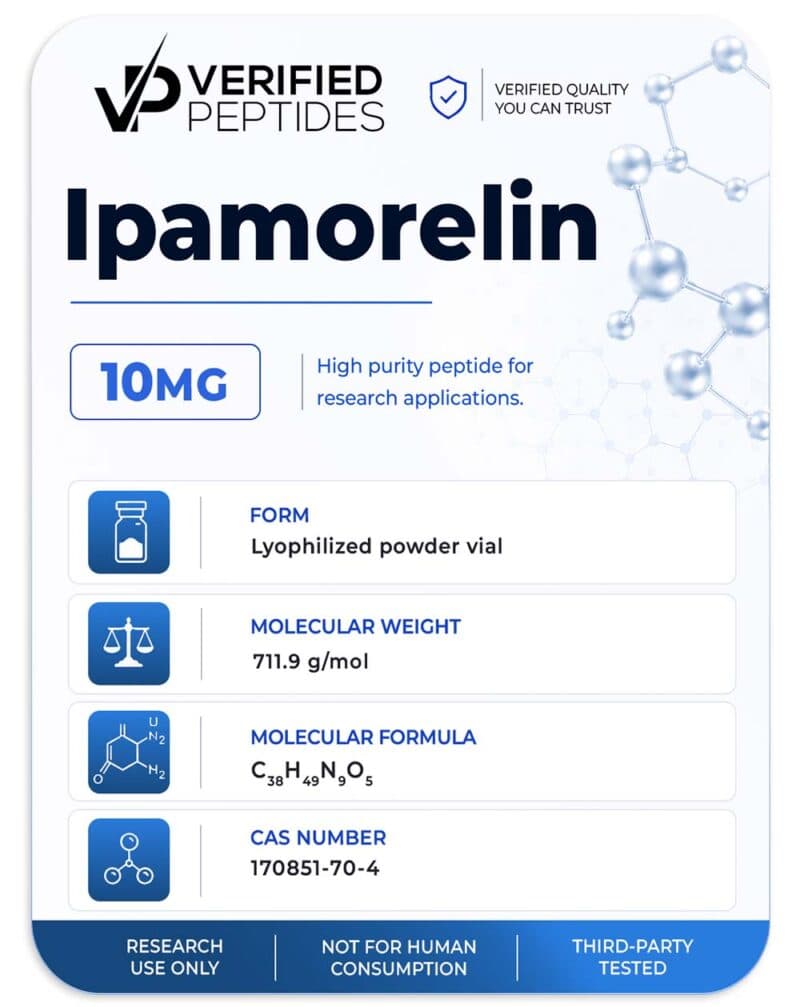
Ipamorelin Peptide (10MG)
0What is Ipamorelin?
Ipamorelin is a selective growth hormone secretagogue peptide that mimics the natural action of ghrelin to stimulate growth hormone (GH) release. Unlike earlier secretagogues such as GHR(P)-2 or GHR(P)-6, Ipamorelin exhibits high receptor selectivity and does not significantly affect cortisol or prolactin levels. In animal and in-vitro research, it has been studied for its potential to enhance growth hormone secretion, support lean body mass development, and aid recovery processes through its co
Frequently Asked Questions
What is Ipamorelin?
Ipamorelin is a selective growth hormone secretagogue peptide that mimics the natural action of ghrelin to stimulate growth hormone (GH) release. Unlike earlier secretagogues such as GHR(P)-2 or GHR(P)-6, Ipamorelin exhibits high receptor selectivity and does not significantly affect cortisol or prolactin levels. In animal and in-vitro research, it has been studied for its potential to enhance growth hormone secretion, support lean body mass development, and aid recovery processes through its co
What is a growth hormone secretagogue used for in animal research?
Growth hormone secretagogues peptides are studied for their ability to stimulate GH release endogenously, supporting investigations into growth deficiency, muscle repair, and metabolic balance.
What are growth hormone secretagogues peptides and how do they work?
They are synthetic peptides that stimulate GH release by binding to GHR(P) receptors, activating hypothalamic-pituitary signaling independently of GHRH.
What makes ipamorelin different from earlier growth hormone secretagogues?
It is the first to demonstrate GH-specific activity without activating the adrenal axis, distinguishing it as a selective GH secretagogue.
What hormonal pathways are unaffected in animals by ipamorelin administration?
Ipamorelin does not alter FSH, LH, PRL, TSH, ACTH, or cortisol—its action is restricted to GH release. 📚 Study References Eur J Endocrinol. 1998 Nov;139(5):552-61.doi: 10.1530/eje.0.1390552. https://pubmed.ncbi.nlm.nih.gov/9849822/ Close Study ▲ // Accordion functionality const accordion = document.querySelector('.research-studies-accordion'); const accordionHeader = document.querySelector('.research-studies-accordion-header'); const closeButton = document.querySelector('.research-studies-close