
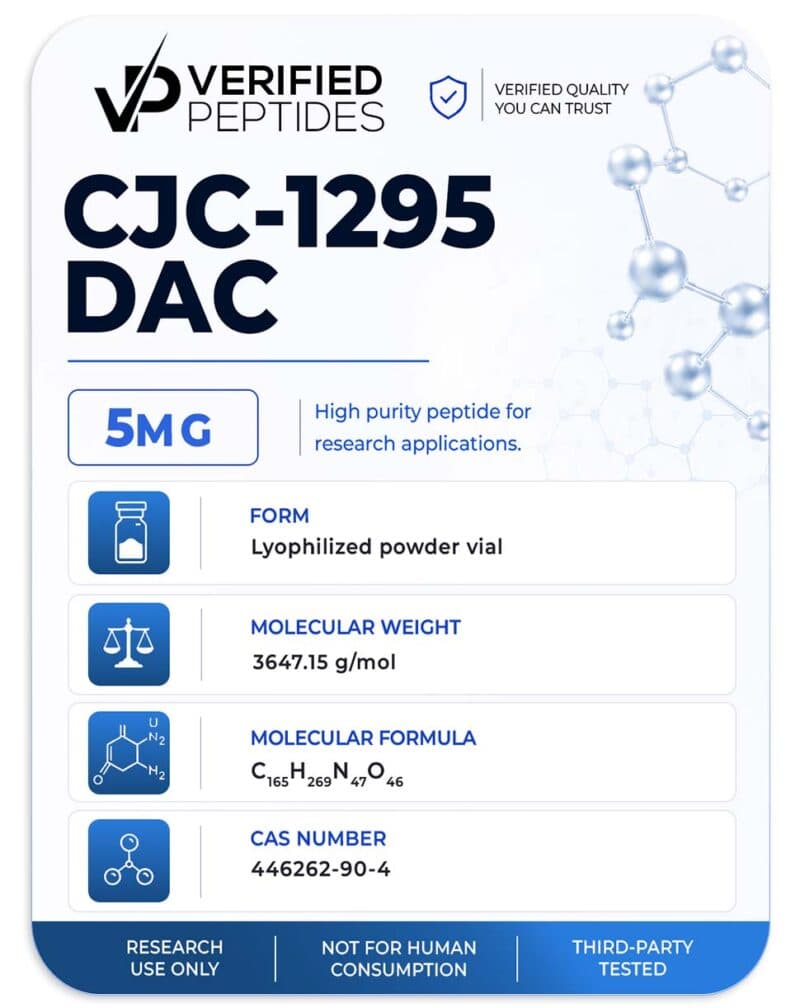
CJC-1295 DAC Peptide (5MG)
0What is CJC-1295?
CJC-1295 is a synthetic growth hormone-releasing hormone (GHRH) analog designed for prolonged biological activity . Unlike traditional short-acting GHRH peptides, CJC-1295 covalently binds to endogenous albumin, forming a drug-affinity complex (DAC) that extends its half-life to match that of albumin. This albumin binding mechanism allows sustained GHRH receptor activation and prolonged GH release. As a long-acting GHRH analog, CJC-1295 represents a new generation designed to overcome rapid enzy
Frequently Asked Questions
What is CJC-1295?
CJC-1295 is a synthetic growth hormone-releasing hormone (GHRH) analog designed for prolonged biological activity . Unlike traditional short-acting GHRH peptides, CJC-1295 covalently binds to endogenous albumin, forming a drug-affinity complex (DAC) that extends its half-life to match that of albumin. This albumin binding mechanism allows sustained GHRH receptor activation and prolonged GH release. As a long-acting GHRH analog, CJC-1295 represents a new generation designed to overcome rapid enzy
What Is CJC-1295?
CJC-1295 is a synthetic GHRH analog designed for prolonged biological activity. Unlike traditional short-acting GHRH peptides, CJC-1295 covalently binds to endogenous albumin, forming a drug-affinity complex (DAC) that extends its half-life to match that of albumin. This albumin binding mechanism allows sustained GHRH receptor activation and prolonged GH release. As a long-acting GHRH analog, CJC-1295 represents a new generation of growth hormone–releasing hormone (GHRH) analogs designed to over
What does CJC-1295 do in research studies?
CJC-1295 acts as a growth hormone–releasing hormone (GHRH) analog that stimulates GH secretion and somatotroph proliferation, supporting growth and anabolic activity in experimental models.
What makes CJC-1295 different from traditional GHRH?
Its albumin-binding mechanism greatly extends peptide half-life, allowing prolonged GH stimulation compared with short-acting natural GHRH.