
Peptide Crafters: Exploring Peptide Synthesis, Research, and Molecular Science
Peptide Crafters and the Molecular Biology of Research Peptides: From Synthesis Principles to Scientific Applications
In modern molecular biology and biotechnology, peptide crafters represent the specialized scientific and technical expertise involved in designing, synthesizing, purifying, and characterizing peptide molecules for research and analytical applications. Peptides occupy an important position between individual amino acids and larger protein structures, serving as molecular tools for investigating cellular signaling, receptor interactions, protein structure, and biochemical regulation. Understanding how peptide materials are created and characterized provides an important foundation for evaluating their role in contemporary scientific research.
Peptide Crafters and the Chemical Foundation of Peptide Synthesis
From a molecular perspective, peptide synthesis is based on the controlled formation of peptide bonds between amino acid residues. A peptide bond is an amide linkage formed between the carboxyl group of one amino acid and the amino group of another. Through repeated coupling reactions, individual amino acids can be assembled into precisely defined peptide sequences.
The work associated with peptide crafters therefore extends beyond simply combining amino acids. Modern peptide production requires careful control of reaction conditions, protecting groups, coupling efficiency, cleavage procedures, and purification processes. Each stage can influence the final chemical composition and analytical characteristics of the resulting peptide.
Because synthetic peptide chains may contain incomplete sequences, deletion products, or other related substances, subsequent purification and characterization are essential components of the overall process.
Solid-Phase Peptide Synthesis: A Fundamental Technology
One of the most important technologies used in modern peptide production is solid-phase peptide synthesis (SPPS).
In a typical SPPS workflow, the growing peptide chain is attached to a solid resin while amino acids are sequentially incorporated according to the desired sequence. Each synthesis cycle generally involves several controlled steps:
- Removal of a temporary protecting group
- Addition and activation of the next amino acid
- Formation of a new peptide bond
- Washing and removal of excess reagents
- Repetition of the coupling cycle
- Final cleavage and deprotection
This approach allows researchers and peptide specialists to construct a wide range of sequences with defined compositions.
The development of automated synthesis platforms has further improved the scalability and reproducibility of peptide production, allowing complex sequences to be prepared for biochemical and molecular research.
Peptide Crafters, Purification, and Analytical Characterization
Following synthesis, the crude peptide generally requires purification before it can be considered a well-characterized research material.
High-performance liquid chromatography (HPLC) is widely used to separate the desired peptide from synthesis-related impurities and closely related compounds. Chromatographic analysis can provide information about the composition of a peptide preparation and help estimate its relative purity.
However, chromatographic purity is only one component of peptide characterization.
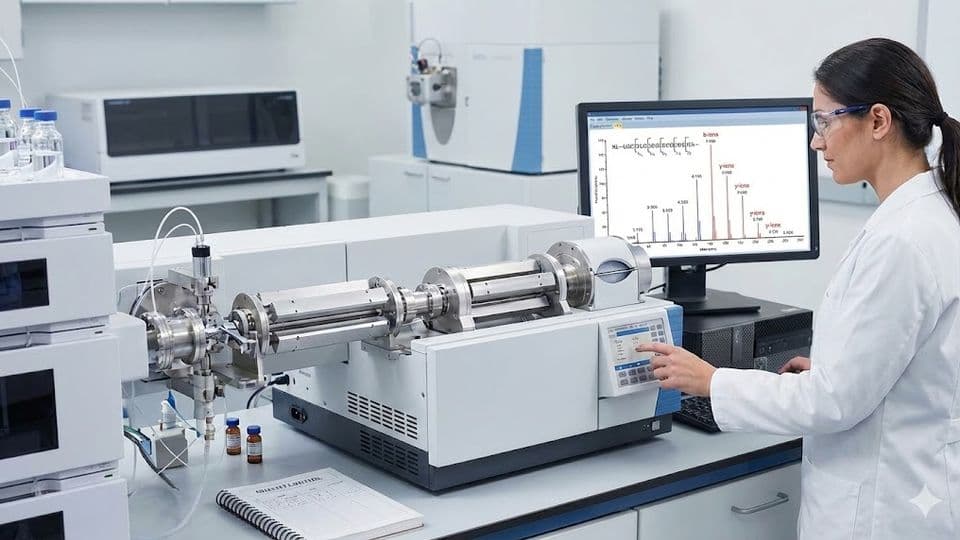
Researchers may also use mass spectrometry (MS) to evaluate molecular mass and support peptide identity. By comparing the experimentally observed mass with the theoretical molecular weight, analytical scientists can obtain additional evidence that the synthesized material corresponds to the intended molecular structure.
Consequently, the modern concept of peptide crafters encompasses not only synthesis but also the analytical processes required to establish the quality and identity of research peptide materials.
Research Peptides and Molecular Biology
Peptides are widely used as experimental tools in molecular and cellular biology.
Their relatively defined structures make them useful for investigating specific molecular interactions and biological pathways. Depending on their sequence and structural properties, research peptides can be used in studies involving:
- Receptor-ligand interactions
- Protein-protein interactions
- Cell signaling pathways
- Enzyme activity
- Molecular recognition
- Membrane-associated processes
- Cellular communication
- Biochemical assay development
Short peptide sequences can also serve as experimental models for studying larger protein domains or specific molecular recognition motifs.
For this reason, accurately synthesized and well-characterized peptide materials can contribute to the reproducibility and interpretation of laboratory experiments.
Quality Control in Modern Peptide Production
Quality control is an essential component of peptide research.
A peptide preparation may contain the intended target molecule together with trace levels of synthesis-related impurities. The actual composition can depend on synthesis efficiency, purification conditions, peptide sequence, and storage history.
Important quality parameters may include:
Purity:
Provides an indication of the proportion of the target peptide relative to detected impurities.
Identity:
Helps establish that the material corresponds to the intended molecular structure.
Molecular Weight:
Provides an important analytical characteristic for confirming the expected peptide composition.
Batch Information:
Allows researchers to associate analytical results with a specific production batch.
Storage Conditions:
Provides information relevant to maintaining peptide stability and material integrity.
Together, these parameters provide a more comprehensive picture of a research peptide than a product name or sequence alone.
Certificates of Analysis and Peptide Documentation
For researchers working with peptide materials, analytical documentation can be an important part of laboratory record keeping.
A Certificate of Analysis (COA) may include information such as peptide name, sequence, batch number, purity, molecular weight, analytical methodology, and testing information.
Such documentation can help researchers:
- Identify the specific material used in an experiment
- Record batch-specific information
- Compare different peptide preparations
- Evaluate analytical specifications
- Maintain consistent laboratory records
For organizations involved in peptide production, providing transparent analytical documentation is therefore an important aspect of scientific communication.
Technological Development and Future Applications of Peptides
Advances in peptide synthesis, purification, analytical instrumentation, and computational molecular design continue to expand the role of peptides in scientific research.
Modern peptide crafters can work with increasingly complex sequences while employing improved analytical methods to evaluate their molecular characteristics. Automated synthesis platforms, high-resolution mass spectrometry, chromatographic techniques, and computational tools have collectively contributed to the development of more sophisticated peptide research workflows.
The growing accessibility of peptide synthesis has also supported research in areas such as:
- Molecular biology
- Biochemistry
- Pharmaceutical research
- Biotechnology
- Structural biology
- Drug-discovery research
- Diagnostic research
- Biomolecular engineering
As analytical technologies continue to improve, researchers can obtain increasingly detailed information about peptide structure, purity, stability, and molecular interactions.
The Scientific Significance of Peptide Crafters
The role of peptide crafters can ultimately be understood as part of a broader scientific workflow connecting peptide design with experimentally useful research materials.
From amino-acid selection and controlled peptide-bond formation to purification, analytical characterization, and documentation, each stage contributes to the quality and reliability of the final material.
For modern molecular biology, the importance of peptides lies not only in their biological functions but also in their value as precisely defined molecular tools. Well-characterized peptide materials can help researchers investigate biological mechanisms, test molecular hypotheses, and develop new experimental methodologies.
As peptide science continues to evolve, advances in synthesis and characterization are expected to further expand the role of peptides in laboratory research and biomolecular science.
Disclaimer: This article is intended solely for scientific knowledge dissemination and academic exchange. It discusses peptide synthesis, characterization, and research applications for informational purposes and does not constitute medical advice, therapeutic recommendations, instructions for human use, or product efficacy claims.